AutomateBusiness systems · 6 min read
Your next customer messaged. Who followed up?
By the Stride IT team
A new enquiry is only the beginning. Learn how a clear owner, visible next action and simple follow-up process can stop opportunities from being lost.
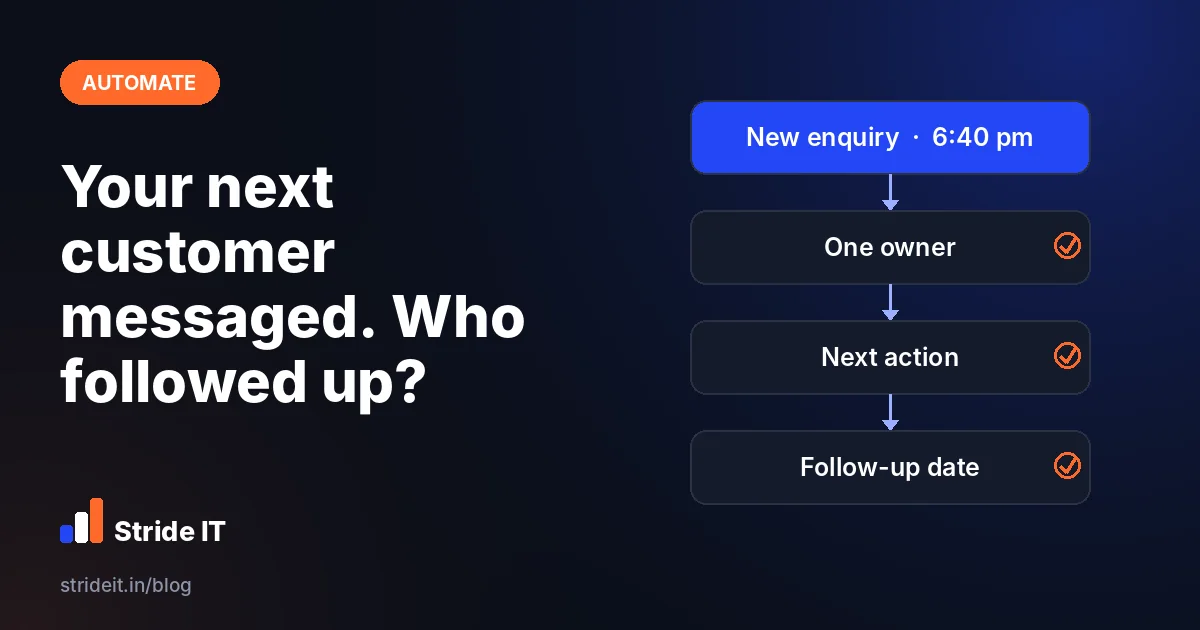
A message arrives on WhatsApp at 6:40 in the evening. Someone saw your post and wants to know the price. Three people in your team see it. By the next morning nobody has replied, because each of them assumed someone else would.
Nothing dramatic happened. No one made a mistake you could point to. The customer simply waited, then messaged someone else. This is one of the quietest ways a business loses money, and it happens after the hard part is already done: the customer found you and asked.
The enquiry is not the hard part
Most growth effort goes into getting attention: posts, ads, a better website. That work matters. But attention only turns into revenue if someone responds quickly and keeps the conversation moving. If your ads or posts are working and sales are not, look at what happens in the first few hours after a message arrives.
Where follow-up usually breaks
- No single owner. When an enquiry belongs to "the team", it belongs to nobody.
- It lives in one person's phone. If that person is busy, on leave or leaves the company, the conversation goes with them.
- No next action is written down. "We'll get back to them" is an intention, not a task.
- No date. Without a follow-up date, the lead drifts until it feels too late to contact them.
- Memory is the system. Everything depends on someone remembering at the right moment.
The same day, with and without a system
Picture two businesses that receive the same three enquiries on a Tuesday: a request for a price, a question about availability and a customer asking to change an order.
Without a system, each message sits in whichever phone it reached. The person who saw the price request is in a meeting. The availability question is answered by someone who does not know the schedule. The order change is mentioned in a call and never written down. By Thursday, two of the three customers have heard nothing useful.
With a simple system, each enquiry gets an owner within the hour, a written next action and a date. The price request is assigned to the person who prepares quotes, with "send quote by 5 pm" beside it. The availability question goes to whoever holds the schedule. The order change is logged against the order. Nobody is working harder. They are just not guessing what to do next.
Four things every enquiry needs
- An owner. One name, not a group. They may ask for help, but they are responsible.
- A visible next action. For example: send the quote, call back at 4 pm, ask for the site address.
- A follow-up date. The day someone will look at this enquiry again if nothing has moved.
- One place where it is recorded. Not three chat apps and a notebook. One list everyone can see.
If you can answer those four points for every open enquiry, you are already ahead of most businesses.
A simple process you can start this week
- Gather every channel into one list. WhatsApp, Instagram messages, calls, the website form, walk-ins. A shared spreadsheet is enough to begin.
- Agree a first-response time you can actually keep. For example, "the same working day". A promise you keep beats a fast one you break.
- Assign an owner when the enquiry arrives. Write the name next to it.
- Write the next action and its date. Every row, every time.
- Hold a ten-minute review each day. Go through anything overdue or without a next action.
- Record how it ended. Won or lost, and why. After a few weeks you will see patterns you could not see before.
When a spreadsheet stops being enough
A shared sheet works until volume grows. You will know it is time for something better when:
- enquiries come from several channels and people copy them over by hand,
- more than a few people handle leads and updates get missed,
- you cannot quickly see what is overdue, or who is overloaded,
- you want reminders to happen automatically instead of relying on a daily review.
At that point a CRM shaped to the way you sell keeps the owner, next action and date on every enquiry and shows overdue work at a glance. Stride IT builds custom CRMs for exactly this, and can add a CRM manager AI that drafts follow-ups for your approval and flags quiet deals.
What to measure
You do not need a dashboard full of numbers. Start with four:
- Time to first reply. How long a new enquiry waits.
- Enquiries with no next action. This should be zero.
- Overdue follow-ups. How many are past their date today.
- Reasons for lost enquiries. Price, timing, no reply, went elsewhere.
If the leads come from paid campaigns, these same numbers show whether your Meta lead generation or Google Ads spend is being used well after the click.
Objections we hear
- "We are too small for a system." Small teams lose the most from a missed message, because each customer matters more. The system can be a shared sheet and a daily habit.
- "Everyone is already busy." Following up properly usually saves time: fewer repeated questions, fewer "did anyone reply?" conversations and fewer surprises.
- "Our customers do not mind waiting." Some do not. But a customer who waited and then chose a competitor never tells you that they were waiting.
- "We will remember." You will, until the week you have twice as many messages as usual.
A first-week checklist
- Write down every place an enquiry can arrive.
- Create one shared list with columns for owner, next action, date and status.
- Decide who is responsible for new enquiries each day.
- Move every open enquiry into the list today, including the old ones.
- Put a ten-minute review in everyone's calendar for the same time each day.
- At the end of the week, count how many enquiries had no owner or next action. That number should shrink every week.
Frequently asked questions
Why do customer messages go unanswered even when the team is busy?
Usually because the enquiry has no single owner. When it belongs to "the team", it belongs to nobody. It may also sit in one person's phone, with no written next action and no follow-up date.
What does every new enquiry need?
An owner (one name, not a group), a visible next action, a follow-up date, and one place where it is recorded that everyone can see.
When is a shared spreadsheet no longer enough for follow-ups?
When enquiries come from several channels and are copied over by hand, when more than a few people handle leads and updates get missed, when you cannot quickly see what is overdue, or when you want reminders to happen automatically.
What should I measure to improve follow-up?
Four things: time to first reply, enquiries with no next action (this should be zero), overdue follow-ups, and the reasons enquiries are lost.